
Edna Florence
She was born on 2nd September 1913 in Aston when her father was 46, and mother Emily 43. She married Cecil Espin in October 1948 when she was 35, and he was 32. Cecil was one of nurse Edna’s patients. Shortly after his birth he contracted meningitis which left him disfigured in physique but not in character – amazing man. He died in 1984 having suffered MS as well. Edna died in 1991 in Warrington, her son David’s home.
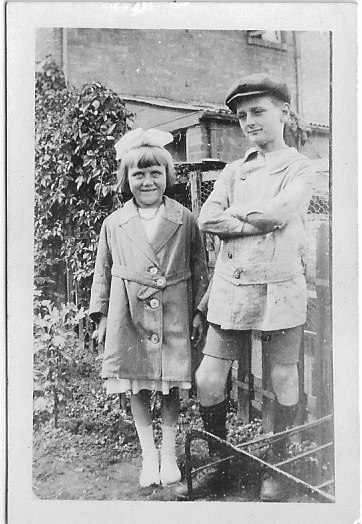

In October 1948, she married Cecil Edward Espin in Birmingham. Cecil was part of the Espin family which comprised Reuben (who married Dorothy, Gladys’ daughter), and Edith and Winifred. The former remained living at her mother’s house at 10 Station Road, Branston, Lincoln and
Winnie moved to the Wirrall on her marriage.

Go to David’s page, their son.


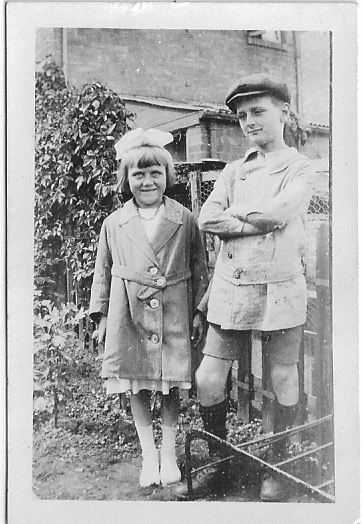
Such a fun and young person. I always enjoyed her company and my summers were spent at Branston in the pre-fab(ricated building) which was enjoyable in itself as I had never slept on the ground floor before. Cecil’s disability was never a hindrance to his good dry as gin humour. He taught me how to make whistles out of Keksi (cow parsley) stalks and sycamore twigs. He suggested I went down the lane to the brook, and identify a sycamore. I came back empty handed, so he tried again, identifying the precise place where it was. I returned once more without finding it, and did so for a further I don’t know how many times, but I found it in the end, and the whistle making process has stayed with me still.

Graham writes:
“Gladys was the eldest of the girls (after a sister died young). Edna was the youngest. As a result Edna and Dorothy were close in age and friends. Cecil, is my fathers, Reuben, brother and his best man. Edna was my mother’s bridesmaid – that’s how they met.”
Harry writes…
“I saw more of Cecil and Enid than Reuben. Whenever we went to Branston, it was a duty call to see Cecil’s Mother at 10 Station Road. It was a line of houses in the middle of nowhere, I think the right hand one. It had a water pump in the front garden, which when I was taken there had not long bee out of commission. The loo was a privy in the backgarden with a very frightening wooden top on which to perch. The house was “two up and two down” quite literally. Might be mistaken, but I thought there were fields at the back. If you walked up the front path and turned left along a way, you came across a hill with houses either side. Writing that, it is impossible as this housing estate would have surrounded the back. The prefabs were on the right at the bottom of the hill I think. Mr Curtiss the butcher called a couple of times a week and his meat was wonderful. Also, the fish and chip van man called although I suspect that was later.

More houses were built along Station Road so the house was renumbered. Enid Espin lived there with her Mother. What a bundle of energy and fun she was; the same in reality as Cecil and Reuben. She once came to stay at 127 Piece Avenue, Olton, for a week or so and the Leamington Spa illuminations were on (November time, I was maybe 7/8 – 1953?) Paul, my friend accross the road was invited and the five of us caught the train to see the lights. On the way there, we obviously played up so Enid picked us up and put us in the luggage racks (the carriages in those days had individual compartments). We tried to get out, but you cannot because of the netting to hold the cases, and the height. Most enjoyable and funny ride. As the years went on I was introduced to John Speed, her friend. He was a really fascinating man who loved old Rover cars, and was a bee keeper. I loved listening to his stories. He drove us all a number of times to Olton at the end of my holidays with them.
Whilst at the prefab, Cecil had worked for a time at Ruston Bucyrus (or Ruston Bycrus as I mistakenly called it and was corrected (quite correctly) by David). David and I would go cycling to go fishing in the dykes and on the River Whitham, with me on his mother’s bike.
Cecil was also an engineer working for Kenwood (the Kenwood Chef people). He had a van with a huge food mixer model on the roof. He was a travelling engineer going from service call to service call. I don’t think there was a passenger seat, or if there was it was uncomfortable. This particular day in early January, there was a very heavy frost and his call was close to Skeggy (Skegness) so we went to the beach afterwards.
Cecil and Edna moved out of the pre-fab [when] and moved into a new three bedroomed house. Looking at Google none of this estate seems to exist now.
As Cecil became more ill, they moved into 24 Abel Smith Gardens, a small bungalow ideally suited to them.


Oh I loved visiting Aunty Edna and Uncle Cecil. The first thing was to run down from 10 station road to the pre-fab so I could use a “real” toilet and not the outside loo! It was an outside building with a bench box. The box had a hole (with smooth sand papered sides) covered by a plywood disc. My aunt Edith used to dig a hole in the garden and empty the contents every couple of days. My issue as a five year old was not so much the smell but the wasps that collected there that frightened me.
Then they moved to the house. Better still. It had, what we call in the US, stucco finish.. It was a new two storied concrete building covered with a yellowish coating. It had a Rayburn coal fired stove for cooking. A toilet with a closing door. Aunt Edna had did not have a roll of toilet paper but a single sheet dispenser!!! What the heck! Davis was trained to go to take a no. 2 every morning. So aunt Edna would send me upstairs to do the same. When I would come down after just a minute she would send me back. Unfortunately. I was not on the same cycle as David. I learnt very quickly to wait a while, then rattles the paper dispenser and then go down for breakfast – it worked!
Graham – more to follow
You and me buddy! Without going into personal habits and rythms, I had exactly the same problem. Edna, and by implication David, was held up by my mother to be a paragon of how to bring up a son. My father had a dose of Epsom Salts every Sunday morning and wouldn’t go outside to work until he had “a call” No doubt I was a sad disappointment and very irregular, and when visiting, David was sent upstairs, I was quite smug that it didn’t happen to me; then mother sent me upstairs and I wasn’t allowed down until I had performed. Clearly when you went there a few years later, he had got the plot. The toilet paper was “San Izal” probably; a gloss finish paper in single sheets (out of a dispenser) the performance of which was totally inadequate for a mopping up operation. If it was that brand – other people remember it also:
“Wet bottoms and shiny paper, San Izal paper. [Archive] – Sheffield …
http://www.sheffieldforum.co.uk › … › General › General Discussions
28 Mar 2008 – 23 posts – 19 authors
Whats the point of San Izal loo roles that are provided in public loos.They have about the same absorbency as a piece of lino.”
As I recall the house was a system build house which was quite an innovation for the time – built around 1950/3 perhaps? Quite correct in the finish and we still call it “Stucco”. In the bungalow, Edna had a fridge. The water tasted quite differently from Birmingham water, a really distinctive taste, which when frozen into cubes had the taste enhanced. Quite a treat as we didn’t have a fridge!
Aunty Edna had a fly killer hanging down from the ceiling. It was a white plastic skeleton. Harry, I remember the brook it was down “Paddocks Lane” David and I spent many days down there. Whenever we went to visitor Branston, Pat and I were told not to wear our best cloths or bring our latest toys. Only to find that David Espin had much better toys, etc.
Uncle Cecil was so nice. .He had such a nice temperament. He built Davis a train track on a swinging table over his bed. He made a doll’s bed for my sister, Patricia, from lathes – the first time I had heard the word, but I remember it to today. I could write on about uncle Cecil and I will in a later post.
Graham